Giorgio Facchini. Jewelry as Traveling Sculpture
- Feb 10
- 3 min read
Updated: Apr 18
The Transferred Legend
A work of art is often cloaked in the legend of the artist who created it. Conversely, a work of goldsmithing transfers the legend to those who choose it and cherish it. Many jewels, even some more recent “designer” pieces, are remembered more for those who have owned them than for their creators. An interesting lesson for modernity! Ever since he created and exhibited his first brooches thirty years ago, while still a sculpture student at the Academy of Fine Arts in Venice, Giorgio Facchini has always conceived his goldsmith creations as "traveling sculptures," thus highlighting what best differentiates a jewel from a sculpture: its mobility, and the portable light - a source of memories - of its precious stones.
The Body in Motion
The goldsmith is a sculptor whose precious creations move in harmony with a woman's body as she displays her beauty. Thus it was in the Golden Age, and thus it is in our more tarnished modern era. In ancient myth, it is the divine blacksmith who creates the art of sculpture; and indeed Hephaestus immediately peoples his world with self-moving golden handmaidens (as Homer described those precursors of automata).
Among modern artists, there has been a growing tendency to make their creations more mobile, freeing them from their statuesque condition – a trend which started with the historic suitcase-sized "travel sculptures," through which Bruno Munari intended once and for all to liberate the statues from their pedestals.
Nomadic Objects
The entire history of man-made objects shows that all our artifacts are initially cumbersome, often immobile, and gradually become more portable or miniaturized. This trend towards portability undoubtedly began with jewelry.
The jewels created by this sculptor from the Marche region have always traveled widely and are esteemed by numerous collectors around the world. Nomadic, highly articulated objects, they have internalized within their forms all the proliferating signs of this mobility: as we enjoy their forms and preciousness, we feel as if we are travelling inside a body of articulated cells.
The Articulation of Form
What is most captivating in Facchini's sophisticated jewels is the highly mobile and inventive articulation of their multiple elements: the serpentine flow of surfaces with their truncated geometries, the signs matured into symbols, the rich, eye-catching inlays that animate this chorus of interlaced and yet articulated forms.
It is the complexity of the structures – ever-changing, protean yet coherent – and the coalescence of light, colors, and reflections, that are the source of this animation.
The Fano Studio
Facchini’s studio in Fano is a showcase for his creations. Alongside his portable sculptures, designed with artisanal expertise for the body, femininity and light – modeling precious materials with a refinement which, in that part of Italy, has drawn inspiration from the essentiality and tenderness of cuttlebone – the visitor can admire the designs and the tangible results of his sculptural practice, which tends toward the abstraction of geometric polyhedra and the secrecy of closed parallelepipeds.
This is accompanied by a code of symbols opened by a script of three-dimensional signs, testifying to his consistent and rigorous research, conducted over time.
The Silver Boxes
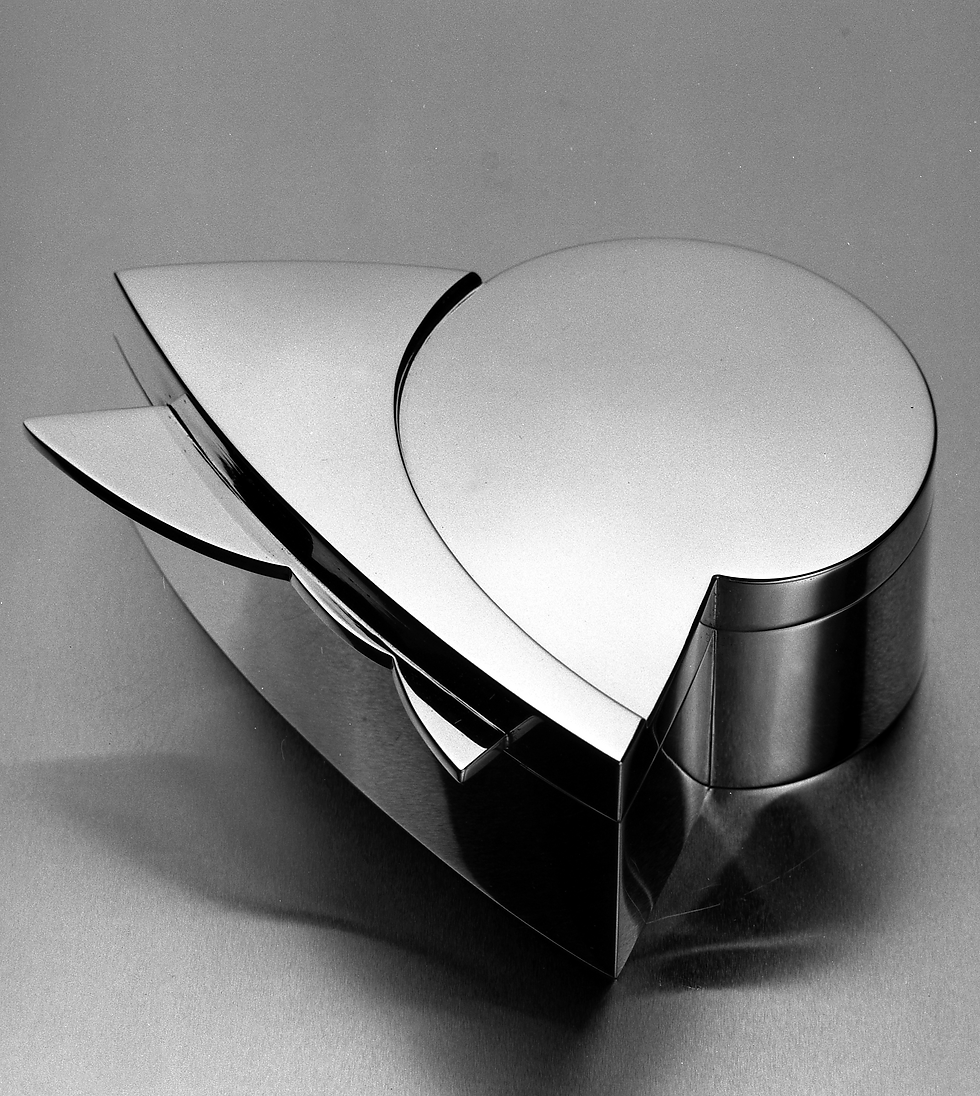
While the reflective silver "boxes" are intermediate between jewelry and more advanced sculpture, maintaining that touch of ritual and divination that wearing jewelry entails, the subsequent wooden structures achieve complete linguistic autonomy.
Such sculpture is no longer destined for the body, but for space; no longer worn, but inhabited.
From Body to Space
Dressing a place is a different challenge from dressing a body. It is not simply a matter of transferring forms from the small scale of the jeweler to the monumental dimension – that would be a poor translation – but rather of conceiving works endowed with the potential for development and growth, capable of proliferating in one or more spaces as and when they choose.
What Giorgio Facchini successfully achieved in the articulation of jewelry continues today in the articulation of the internal elements of large-scale sculptural projects, which are also protean and aggregating, capable of establishing intense relationships with the space that hosts them.


